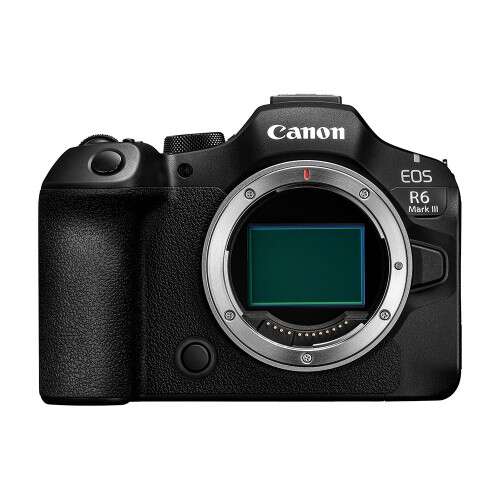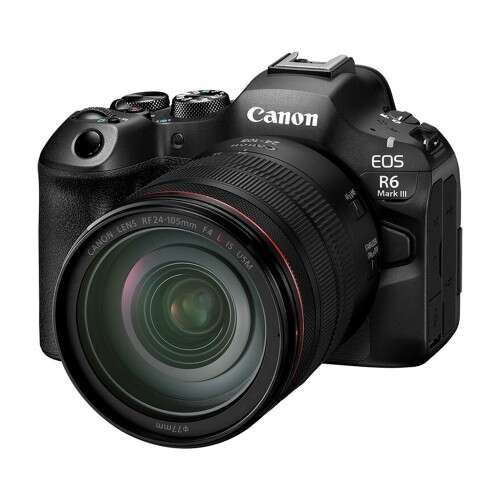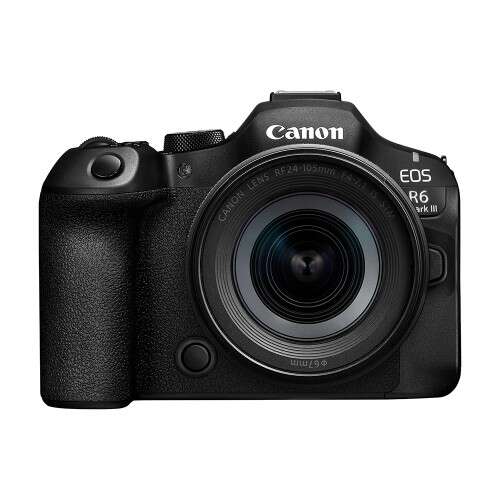
Canon EOS R6 III
Key specifications
- 32MP full-frame CMOS sensor
- In-body image stabilization rated up to 8.5 stops
- 40 fps burst shooting with pre-capture
- Fully articulated 3.0" 1.62M-dot rear screen
- 7K recording up to 60p (Canon Cinema RAW Lite)
- Oversampled 4K <60p, plus 4K 120p
- 3:2 Open Gate recording up to 30p
The Canon EOS R6 III will be available from late November.
What’s new?
New sensor

The 33MP front-side illuminated CMOS sensor at the heart of the EOS R6 III is new to Canon’s hybrid mirrorless lineup, having recently appeared in the cinema-focused EOS C50. Canon isn’t claiming specific sensor technology breakthroughs here, but initial testing suggests faster readout speeds than the lower-resolution chip used in the EOS R6 II. As is typical for Canon, it uses a dual-pixel design with two sub-pixels at every photosite, enabling full-sensor phase-detect autofocus.
Faster readout, combined with changes to the card slot and processor (Canon says it’s the same generation with some improvements), brings meaningful upgrades for video capture. The stabilization system has also been slightly improved, moving from 8 stops to 8.5 stops.
Updated ports

The EOS R6 III replaces one of the previous model’s two UHS-II SD card slots with a CFexpress Type B slot. While you can still use most features with an SD card, recording RAW video requires faster (and typically more expensive) storage.
Canon has also replaced the EOS R6 II’s micro HDMI port with a full-size HDMI port, a much more robust choice for a camera intended to be a serious workhorse.
Improved burst workflow
While maximum burst speeds remain the same, the EOS R6 III improves the experience by removing the need to use a dedicated RAW Burst mode to enable pre-capture. A pre-continuous shooting option can now be enabled directly in H+ drive mode. Canon says the CFexpress slot and its higher sustained write speeds are a major reason this is possible.
RAW Burst mode is no longer present. Although it offered some benefits (like showing a burst as a single thumbnail in playback), it was a cumbersome workflow. Editing outside Canon’s software required extracting and saving frames as standard CR3, JPEG or HEIF files. That extra step is no longer necessary.
RAW video, 7K and open gate

The Canon EOS R6 III can now record internal RAW video up to 7K/60 using Canon’s Cinema RAW format. It can also shoot open-gate footage up to 7K/30, capturing the full sensor area to produce a 3:2 image that can be cropped vertically or horizontally in post.
The recording mode menus have also been updated. The EOS R6 II presented a long list of resolution / frame rate / compression combinations; the EOS R6 III allows you to select these independently, making setup quicker and clearer.
A dedicated red tally lamp has been added, making it obvious to both the operator and on-camera talent when recording is active.
Autofocus updates
The autofocus system appears largely similar to the EOS R6 II, with subject recognition for people, animals and vehicles, plus an auto mode. Canon says the underlying algorithms have been updated in line with cameras like the EOS R1 and EOS R5 II, improving reliability.
The EOS R6 III also includes a Register People Priority feature, allowing the camera to learn specific individuals and prioritize tracking them over other people in the scene.
Although the cameras are broadly described as using “Digic X” processors, Canon says intergenerational improvements help enable some of the EOS R6 III’s new capabilities.
What is it?

The EOS R6 III is Canon’s full-frame enthusiast camera, designed to perform well across a wide range of genres. Like others in this class (and its predecessor), it’s suitable for most kinds of photography—from landscapes to fast action and sports—while also offering video features that until recently were reserved for dedicated cinema cameras. It also includes weather sealing and dual card slots.
Naturally, there are still differences compared to higher-end stacked-sensor models like Canon’s EOS R5 II. You don’t get some pro-focused features such as eye-controlled AF point selection, built-in AI upscaling and certain action priority modes. Canon has suggested some of these features require additional co-processing hardware that would have pushed this camera beyond its intended budget.
It can shoot 40 fps bursts for up to 150 seconds in RAW+JPEG and supports pre-capture—useful if your timing is slightly late. Unlike the EOS R6 II, these features no longer require a separate, more complicated RAW Burst mode.

Canon includes its now-standard autofocus subject recognition for people, animals and vehicles, plus an automatic mode that looks for subjects in the scene. It also supports registering a specific person and prioritizing them for subject selection.
The camera supports HDR output, including 10-bit HEIF stills using the PQ tone curve, and can capture HDR video using PQ or HLG. Open-gate recording above 4K provides additional flexibility for reframing and delivery formats in post-production.
The EOS R6 III in context
The EOS R6 III enters a highly competitive segment. Its predecessor remains a sensible option, so it’s included here alongside the Nikon Z6III, which offers a similar blend of speed, advanced autofocus and strong video specs. The Sony a7 IV is also included due to its 33MP sensor, though it can’t match the burst speed of the others.
| Canon EOS R6 III | Canon EOS R6 II | Nikon Z6III | Sony a7 IV | |
|---|---|---|---|---|
| Sensor type | Dual Pixel AF FSI CMOS | Dual Pixel AF FSI CMOS | Partially stacked CMOS | BSI CMOS |
| Resolution | 33MP | 24MP | 24MP | 33MP |
| Max burst rate | 12 fps mechanical / 40 fps electronic | 12 fps mechanical / 40 fps electronic | 14 fps mechanical / 20 fps electronic / 60 fps JPEG only | 10 fps (lossy RAW) |
| Pre-capture | Yes | Yes (RAW Burst mode) | Yes (JPEG only) | No |
| Image stabilization | 8.5 stops | 8 stops | 8 stops | 5.5 stops |
The Z6III’s partially stacked sensor shows higher read noise than some competitors, which can be a disadvantage when pushing deep shadows (though it doesn’t affect midtones). We’ll need production EOS R6 III samples to see how it compares in that area. In any case, it’s worth checking lens availability and ecosystem considerations before choosing a system, especially given third-party lens restrictions that can apply across brands.
While the a7 IV remains capable, it can feel dated in some areas: rolling shutter performance at full width is relatively poor, it lacks internal RAW video, and although autofocus is strong, it’s no longer Sony’s best. Sony’s E-mount supports third-party lenses, but users should note that Sony can limit burst performance with non-Sony lenses on some bodies.
Body and handling

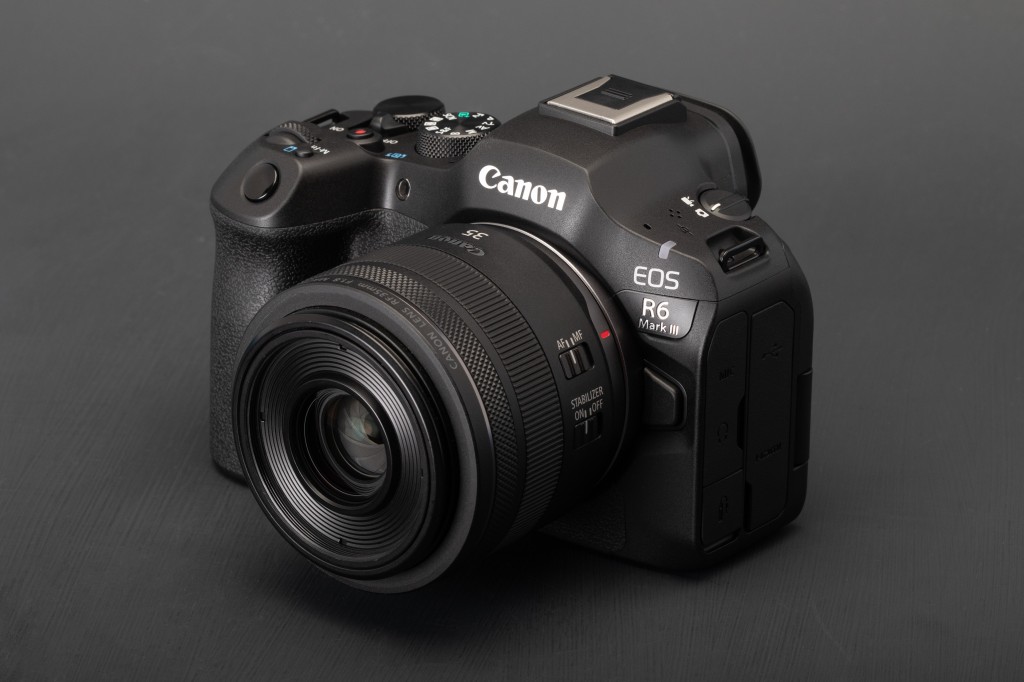
The EOS R6 III closely follows Canon’s established design formula and looks very similar to the EOS R6 II, though not identical. It features a substantial grip that remains comfortable even with heavier lenses attached. There are nine customizable buttons total, and they can be assigned differently for stills and video. Switching between stills and video is handled by a dedicated lever to the left of the electronic viewfinder.
The AF joystick and surrounding controls are positioned to fall naturally under your thumb while holding the camera, and the layout helps you identify controls by feel even when your eye is to the EVF.
Press Release
Canon today announces the EOS R6 Mark III, a full-frame mirrorless camera designed for hybrid creators who want fast stills performance and advanced video tools in a compact, weather-sealed body. The camera features a newly developed 32MP full-frame CMOS sensor and in-body stabilization rated up to 8.5 stops, helping users capture sharp results handheld across a wide range of situations.
Built for speed, the EOS R6 Mark III delivers up to 40 fps continuous shooting with pre-capture to help ensure decisive moments aren’t missed. Canon’s Dual Pixel autofocus system supports intelligent subject detection and tracking, including updated algorithms and the ability to prioritize registered individuals for more consistent focus in dynamic scenes.
For video creators, the EOS R6 Mark III expands internal recording options with 7K RAW capture up to 60p and Open Gate (3:2) recording up to 30p, enabling flexible reframing for multiple delivery formats. Oversampled 4K recording at up to 60p and high-frame-rate 4K at up to 120p are also supported, providing a range of quality and workflow choices.
The camera introduces a faster media configuration with one CFexpress Type B slot alongside a UHS-II SD slot, and includes a full-size HDMI port for more reliable connection to monitors and recorders. A dedicated tally lamp makes it easier for operators and on-camera talent to confirm when recording is active.
With the EOS R6 Mark III, Canon brings high-speed capture and modern video capabilities to a versatile full-frame platform, supporting photographers and filmmakers who need a dependable hybrid tool for everyday shooting, travel, events and professional content creation.